
Xishuangbanna: Cradle of the Broad-Leaf Tea Tree
A field survey of Xishuangbanna’s vertical climates, montane forest ecosystems, and the ecological contrast between ancient arbor stewardship and modern terrace plantations.
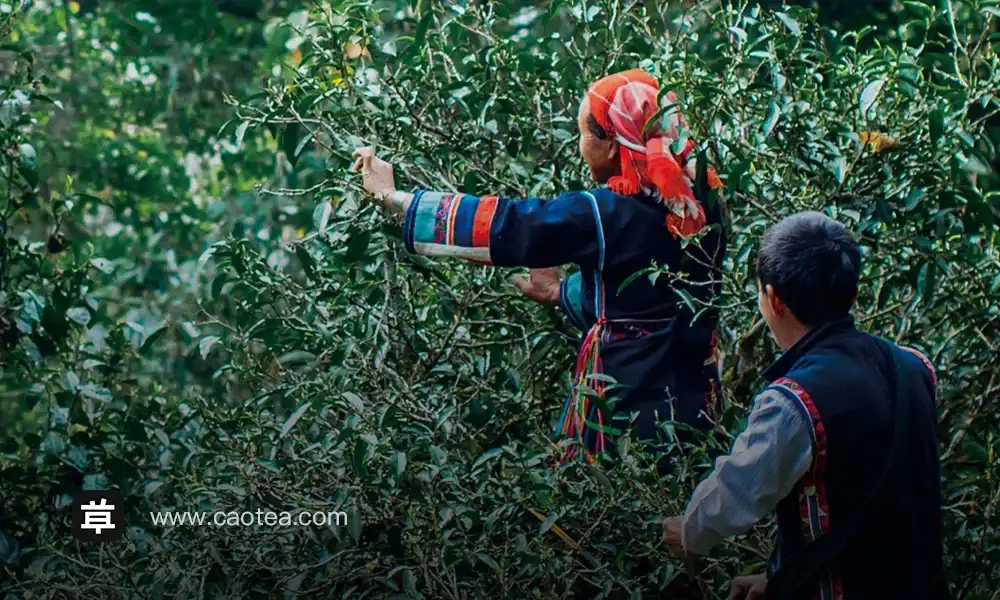
Before venturing deep into the tea mountains, it is essential to understand Yunnan's distinctive natural geography. Situated on China's southwestern frontier, Yunnan borders the Tibet Autonomous Region as well as Myanmar, Laos, and Vietnam. It serves as the evolutionary cradle of the world's tea plants and the historic crossroads of the Ancient Tea Horse Road, possessing millennia of rice-farming heritage and tea tree domestication.
Steep mountain ranges, deep valleys, and dramatic elevation gradients form the physical backbone of Yunnan. Raging river systems—most notably the Lancang (Upper Mekong) and Nu (Salween)—carve north to south through the terrain, producing a sharply stratified vertical climate that yields the local phenomenon known as "four seasons on a single mountain, and distinct weather within ten miles." This three-dimensional microclimate makes Yunnan one of the globe's premier biodiversity sanctuaries, supporting an enormous population of higher plants and rare wildlife.
Within the tea industry, Yunnan's growing regions are customarily divided into four core areas: Lincang, Pu'er, Xishuangbanna, and Dali. Smaller volumes with distinct regional character also originate from Baoshan and Wenshan. While subsequent reports will examine other territories, this survey focuses primarily on Xishuangbanna.
The Natural Sanctuary of Xishuangbanna
The Xishuangbanna Dai Autonomous Prefecture is located at the southernmost tip of Yunnan, administering Jinghong City, Menghai County, and Mengla County. It occupies the mountainous nexus where the Hengduan Range extends down into the Indochinese Peninsula. Hundreds of millions of years ago, tectonic collisions within the Eurasian plate folded this landscape into a labyrinth of towering crests and sheer ravines. Within its montane forests between 1,200 and 2,000 meters above sea level, a low-latitude subtropical climate and balanced humidity sustain luxuriant native vegetation, with floral biodiversity ranking among the highest worldwide. Each indigenous minority that has resided here for generations preserves its own ancient folklore concerning the origin and domestication of the tea tree.

Flying southwest from the provincial capital of Kunming—a distance of roughly 500 kilometers—takes just 50 minutes to reach Xishuangbanna. Looking out through the cabin windows, the 3,000-meter peaks of the Ailao and Wuliang mountain ranges stand above the sea of clouds, serving as natural barriers against northern cold air masses and retaining equatorial moisture. As the flight proceeds south, the rugged topography gradually softens into undulating basins, and the dense, warm humidity becomes palpable.
Originating in the glaciers of the Qinghai-Tibet Plateau, the Lancang River courses through the entire length of Xishuangbanna. Once it crosses the Chinese border, this vital artery is known as the Mekong, ranking as Asia’s third-longest river with a total length of approximately 4,500 kilometers, flowing through Myanmar, Laos, Thailand, Cambodia, and Vietnam before emptying into the South China Sea. Heading downriver by vessel from Jinghong Port, one can cross the frontier mountains directly to Chiang Saen in Thailand. While this rugged expanse bordering the Golden Triangle was once notorious for international narcotics trafficking, the deep mountain interiors along both banks have remained peaceful agricultural sanctuaries since antiquity.
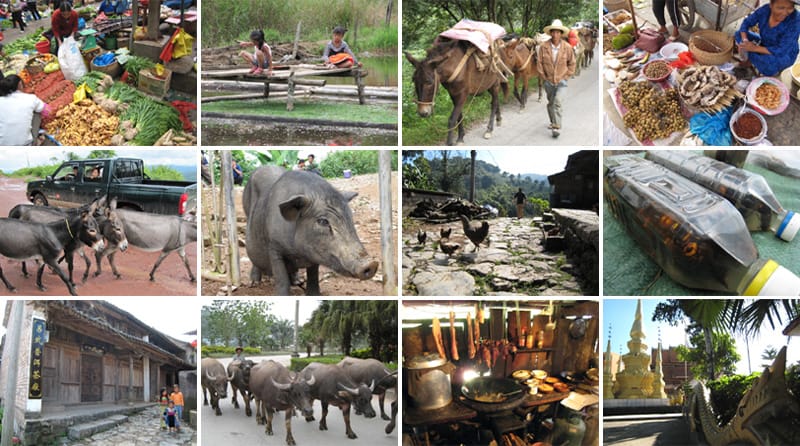
Xishuangbanna enjoys a temperate climate without scorching summers or severe winters, allowing its wooded mountains to stay verdant through all four seasons. Across the intermontane basins, ancient wet-paddy farming continues uninterrupted. Menghai County in particular has long been celebrated as the "Granary of Southwestern Yunnan," where the renown of its rice cultivation historically predated that of its tea. This zone is one of the ancestral cradles of Southeast Asian wet-rice culture, giving rise to unique culinary and cultural traditions centered on rice. The name "Xishuangbanna" derives from the Dai term Sipsongpanna, meaning "twelve administrative thousand-field districts" (historically designating units used for taxation and local governance). This agrarian abundance provided the economic foundation that allowed Theravada Buddhist culture to flourish. The ancestors of the Dai—the region's primary indigenous group—migrated southward from this basin to establish the historic Lanna Kingdom in northern Thailand. Today, 13 indigenous ethnic groups account for over 70% of the prefecture’s 1.3 million residents, with roughly one million people engaged in agriculture, sustained by the surrounding soil and forests.
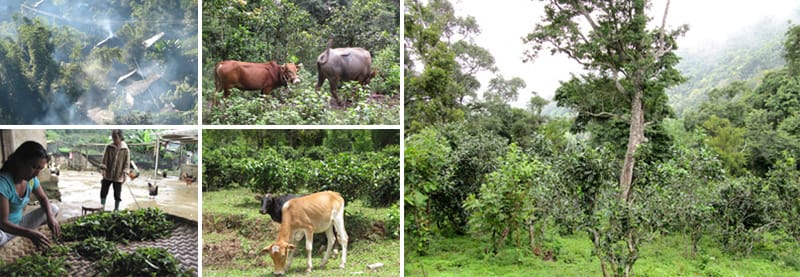
With ongoing transport infrastructure upgrades, Xishuangbanna has emerged as a popular travel destination, bringing commercialized retro-style quarters and staged folk performances to urban edges. Yet once travelers leave the bustling towns and venture into the mountain hinterlands, the authentic character of this land becomes apparent. Highland agriculture remains organized around family units; farming households cultivate vegetable plots along forest clearings, raise domestic livestock, and maintain a semi-subsistence rhythm of life.
This ecosystem provides refuge for 756 wild animal species—more than a quarter of China's total faunal inventory. Confirmed wildlife records include 108 mammal species, 427 bird species, 47 amphibian species, and 74 reptile species, with 179 species listed under national priority protection. In addition to preserving China's largest remaining population of wild Asian elephants, these forests shelter gaur (wild cattle), Indochinese tigers, green peafowl, monitor lizards, Burmese pythons, and the rare lesser mouse-deer, which in China is found exclusively in this prefecture.
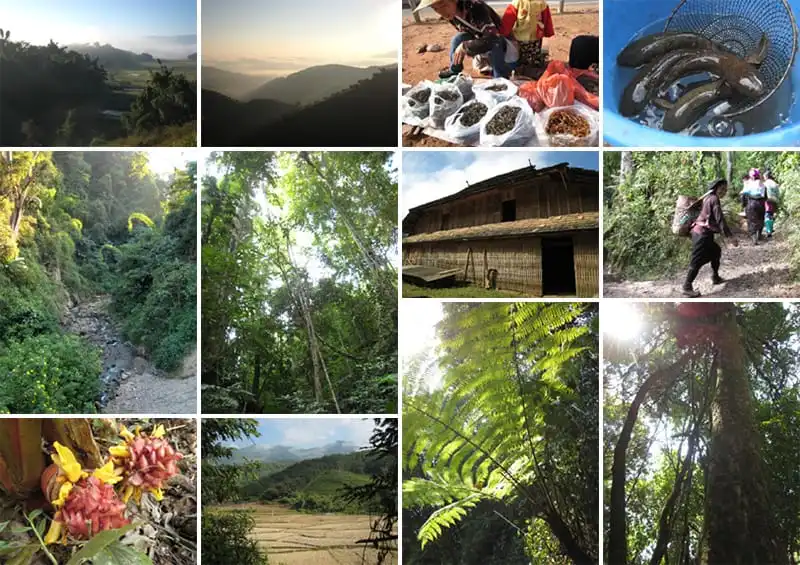
Vertical Climates and Three-Dimensional Farming
Driven by extreme topographic elevation drops, Xishuangbanna exhibits a structured vertical climatic zonation:
- Northern Tropical Zone (Below 800m): River valleys and basin lowlands, mainly producing tropical fruits, sugarcane, and off-season plateau vegetables.
- South Subtropical Zone (800–1,500m): Rolling hills and plateau terraces, dominated by natural rubber plantations, flue-cured tobacco, and ornamental flowers.
- Middle Subtropical Zone (1,500–2,000m): High-altitude montane forests, representing the core elevation band where premium ancient tea arbors survive and develop complex profiles.
- North Subtropical Zone (Above 2,000m): Sub-alpine crests characterized by cold-temperate conditions, dominated by primary and secondary montane forests and sub-alpine scrub.
Traveling by vehicle from the valley floor to the high ridges can produce temperature swings of up to 15°C, accompanied by shifts in vegetation patterns. In recent decades, driven by growing automotive and tire manufacturing industries across Asia, large-scale commercial rubber cultivation pushed into the lower foothills, drawing investment from multinational firms, including Australian enterprises. Lower elevations also saw expanded cultivation of medicinal herbs used for traditional herbal teas. However, because the prefecture's economic core has centered strictly on forestry and agriculture, its high-altitude tea forests have remained unmarred by modern heavy industry.

Ancient Tea Arbors in Native Forests
Within the high montane forests of Xishuangbanna, ancient tea trees dating back several centuries continue to survive.
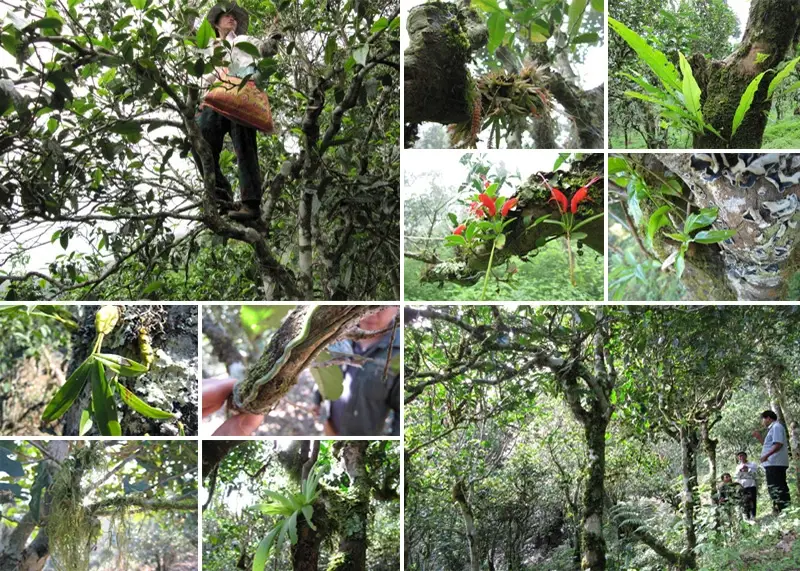
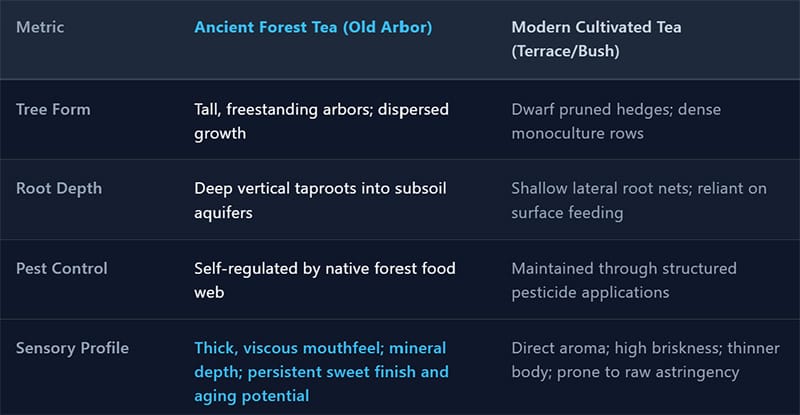
Generations of tea farmers have adhered to traditional agroforestry practices, consistently rejecting synthetic chemical fertilizers and pesticides. Unlike modern commercial plantations that rely on low-pruned, closely spaced hedges planted in uniform terraces, ancient tea arbors grow as independent trees dispersed through mixed natural forests. Because these trees were propagated from seed rather than modern clonal cuttings, they possess high genetic heterozygosity. Within a single forest plot, ancient tea trees display variations in leaf size, shape, and hue—ranging from pale yellow and emerald to reddish-brown and deep purple—resulting in a diverse spectrum of cup profiles.
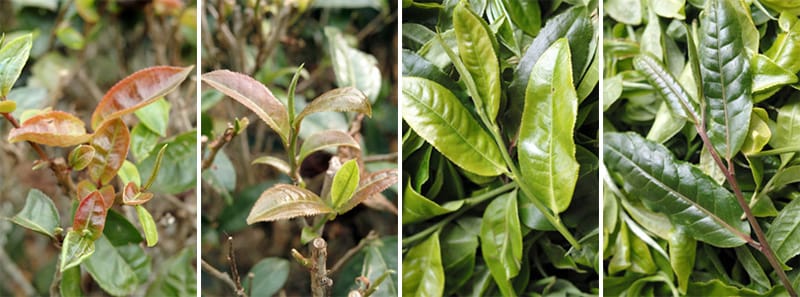
Botanically, these heritage trees belong to the Yunnan broad-leaf variety (Camellia sinensis var. assamica), characterized by thick leaf pulp and sturdy, rounded stems. Compared to intensive, high-yield modern tea gardens, their annual yield per acre is low. However, their primary root systems plunge meters down into rocky subsoils, absorbing minerals and trace elements that produce ancient-tree Pu-erh's dense texture, lingering salivation (shengjin), and deep forest resonance (shanyeqiyun).

Highland minority communities sustain this ecosystem through cyclical, symbiotic agroforestry. Families balance mixed farming and animal husbandry, gathering fallen branches from backwoods to fuel roasting woks, keeping bees to assist tea blossom pollination, composting livestock manure for food plots, and protecting native headwater forests. These ancient tea stands represent an integral cog within this ecological energy cycle, stabilizing mountain watershed soils. Epiphytic mosses, dendrobium orchids, lichens clinging to tree trunks, along with canopy insects and native birds, form an ongoing food web that requires no artificial intervention.
Over generations of cultivation, different ethnic groups developed distinct traditions of tea tree stewardship:
- The Yao, Yi, and Han: Influenced by central plains tea practices since the Ming and Qing dynasties, they place greater emphasis on structural pruning and understory clearing, pursuing higher aromatic lift and clarity through structured tree care.
- The Aini (a branch of the Hani), Blang, and Jino: As indigenous highland farmers with a long history of sedentary agriculture, they exercise restraint in managing tea trees, allowing them to grow naturally into tall arbors. Historically supplying trade caravans along the Ancient Tea Horse Road bound for Tibetan Buddhist monasteries and nomadic populations, their harvest styles favored bold, heavy, astringent profiles well-suited for long-term aging and post-fermentation.
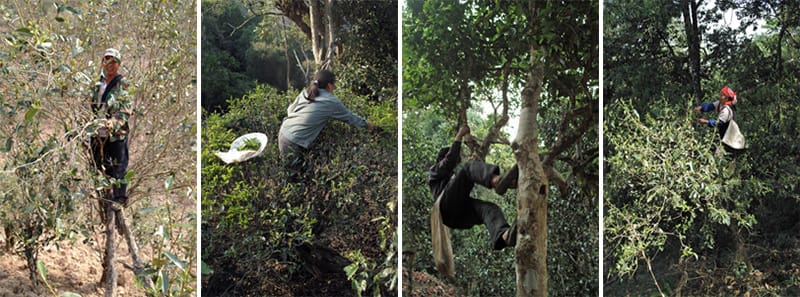
- The Lahu and migratory branches of the Yao and Blang: Influenced by their historical forest foraging and hunting traditions, they continue to hike deep into unmanaged old-growth tracts during the spring plucking season to harvest "wild-growing tea," an approach that remains close to natural wildcrafting.
The True Nature of Wild Tea Trees
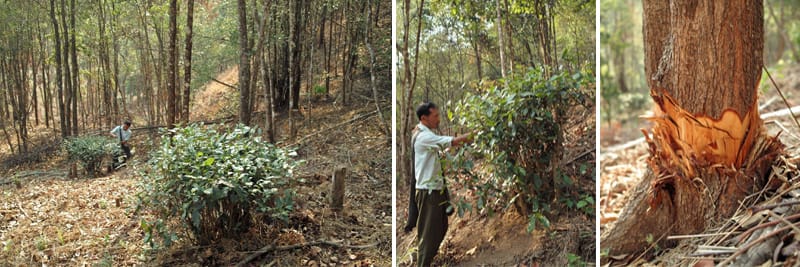
Deep within dense forests far removed from farmland, one occasionally encounters uncultivated wild tea trees. These specimens thrive in semi-shaded forest tracts beneath mixed hardwoods, sending straight trunks skyward in competition for sunlight. (Botanists and agronomists continue to research whether these large forest trees are unadulterated primordial wild species or feral escapes domesticated by early humans and abandoned centuries ago.)
When harvesting remote mountain tea trees, farmers carry cast-iron woks deep into the hills to complete the kill-green (shaqing) processing on-site inside rustic shelters, turning leaf into sun-dried loose tea (maocha). Unlike domesticated cultivars, native wild tea trees typically flush only once a year, in mid-April as temperatures climb just ahead of the monsoon rains. As a result, they do not exhibit the sweet, tender amino-acid profile characteristic of early spring garden flushes. Furthermore, to survive against wild herbivores and pests within the primary forest, wild tea trees synthesize defense compounds; their raw leaves are loaded with intense, bitter alkaloids and high levels of anthocyanins. Brewed fresh, their infusions can taste sharply astringent or pungent, occasionally causing gastrointestinal irritation.
While market vendors label many commercial offerings as "Wild Tea" (Yesheng Cha), the vast majority are derived from abandoned, semi-feral arbor stands (Huangshan Cha) originally planted by humans decades or centuries ago. Scientifically genuine primordial wild tea trees remain scarce, and most are cataloged under national wild flora protection programs that forbid destructive commercial harvesting.
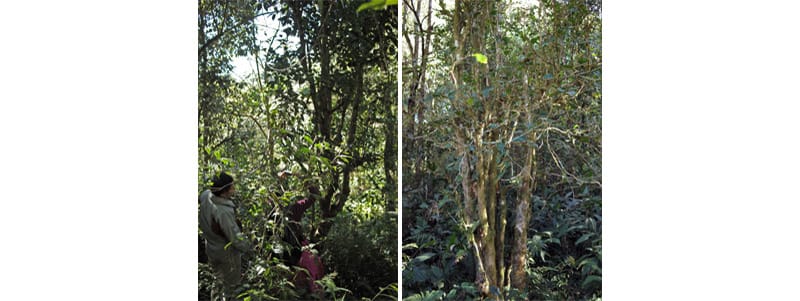
Across the history of these tea mountains, shifts in settlement and agricultural priorities left many former hillside terraces to be reclaimed by secondary woodland, leaving behind thick-trunked feral tea arbors shrouded by forest canopies. With rising market demand for old-tree raw material, the revitalization of these state-managed forest parcels (Guoyoulin) has grown popular. By clearing dense choking brush, thinning overstory canopies, and lightly pruning dead wood to restore light penetration, growers can re-harvest clean, expressive forest spring leaf by the following season.
The Industrial Rise of Terrace Tea Gardens
Examining international tea trade history reveals that China's traditional tea sector lost its global market dominance in the late 19th and early 20th centuries primarily because the British established industrial plantation systems in Assam, India, and Ceylon (now Sri Lanka). Leveraging mechanized, large-scale processing, these enterprises flooded global markets with low-cost black tea, putting China's traditional, family-run workshop model at a competitive cost disadvantage.
Following the founding of the People's Republic of China in 1949, Xishuangbanna began developing modern commercial tea gardens to restore industrial-scale tea production along the southwestern frontier.
Agricultural research institutes adopted overseas monoculture practices, promoting high-density, low-pruned, contoured hedge plantations arranged across stepped hillside terraces. Known in the tea sector as "terrace tea" (Taidi Cha) or "new tea gardens" (Xin Chayuan), this neatly terraced layout spread across southern China over recent decades, becoming the standard visual archetype of a tea garden in modern public perception.

The perfection of artificial pile-fermentation (wodui) technology for ripe Pu-erh (Shou Cha) in 1973 created sustained demand for large volumes of affordable, uniform raw material. After 2000, as Pu-erh appreciation expanded through mainland China, Hong Kong, and Taiwan, the land area and harvest yields of terrace plantations expanded rapidly. Agricultural research centered on high-yield farming practices, fast-growing clones, and fertilizer programs designed to accelerate flush regeneration.
Terrace plantations receive unobstructed sunlight and yield flush shoots rapidly, making harvesting efficient. However, because soil nutrients are drawn up by an immense volume of fast-growing buds over short cycles, their liquor density, infusion endurance, and lingering sweetness remain less complex than those harvested from deep-rooted forest arbors.
Ecological Re-Evaluation of the "Plantation Decade"
Driven by surging domestic consumption, the Pu-erh tea trade evolved into a speculative market around 2006. Chasing rapid returns, developers cleared native forest tracts, with some operators clearing hillsides to establish terrace plantations on bare ground.
Along roadways leading to celebrated tea villages such as Lao Banzhang, large plots were cleared and graded for new terraces. To maximize sunlight exposure and picking convenience, surrounding native broad-leaf hardwoods were cleared away. However, continuous single-crop monoculture disrupted local ecosystems. The loss of native animal and insect habitats triggered recurring pest infestations, thin topsoils washed away, and shallow-rooted bushes succumbed to root-rot diseases. These issues led operators into an intensive cycle of synthetic pesticide spraying and chemical fertilizer feeding to force budding.

Indiscriminate forest clearing on steep slopes compromised mountain headwater retention and topsoil stability. In contrast, ancient tea arbors maintained within forest biospheres reflect long-term agroforestry stewardship. While ancient arbors produce limited seasonal yields that require manual hand-plucking—keeping raw leaf costs high—this investment directly safeguards original forest ecosystems. High-grade spring tea from old arbors offers layered sensory complexity shaped by centuries of natural forest nourishment, providing lasting agricultural and historical value.
This concludes the article. The following is a preview of the next installment.
Flanking the Lancang River: The Terroirs of Mengla and Menghai
Across Yunnan, the distribution of heritage tea tree genetics aligns closely with the drainage basin of the Lancang River. Within Xishuangbanna, the river flows from the northwest to the southeast, dividing the prefecture's core tea regions into two distinct territories:
- East of the River (Jiangnei ) — Mengla County: Anchored by the historic Six Ancient Tea Mountains (Yiwu, Youle, Mangzhi, Manzhuan, Gedeng, and Yibang). Teas from this bank are celebrated for their fine-textured liquor, soft yet structured balance, elevated floral aromatics, and lingering sweetness.
- West of the River (Jiangwai ) — Menghai County: Anchored by the modern tea mountains (including the Bulang Range, Nanqiao, Bada, Nannuo, Mengsong, and historically Jingmai—note: Jingmai now falls administratively under Lancang County, Pu'er City). Teas from this bank are known for their bold power (chaqi), upfront bitterness, and rapid, long-lasting sweet return.
Contrasting geological formations, distinct microclimates, and diverse ethnic processing approaches have given the two banks of the Lancang River their own recognizable flavor profiles and market standing. Detailed profiles of Mengla and Menghai’s specific mountain terroirs will follow in upcoming reports.